



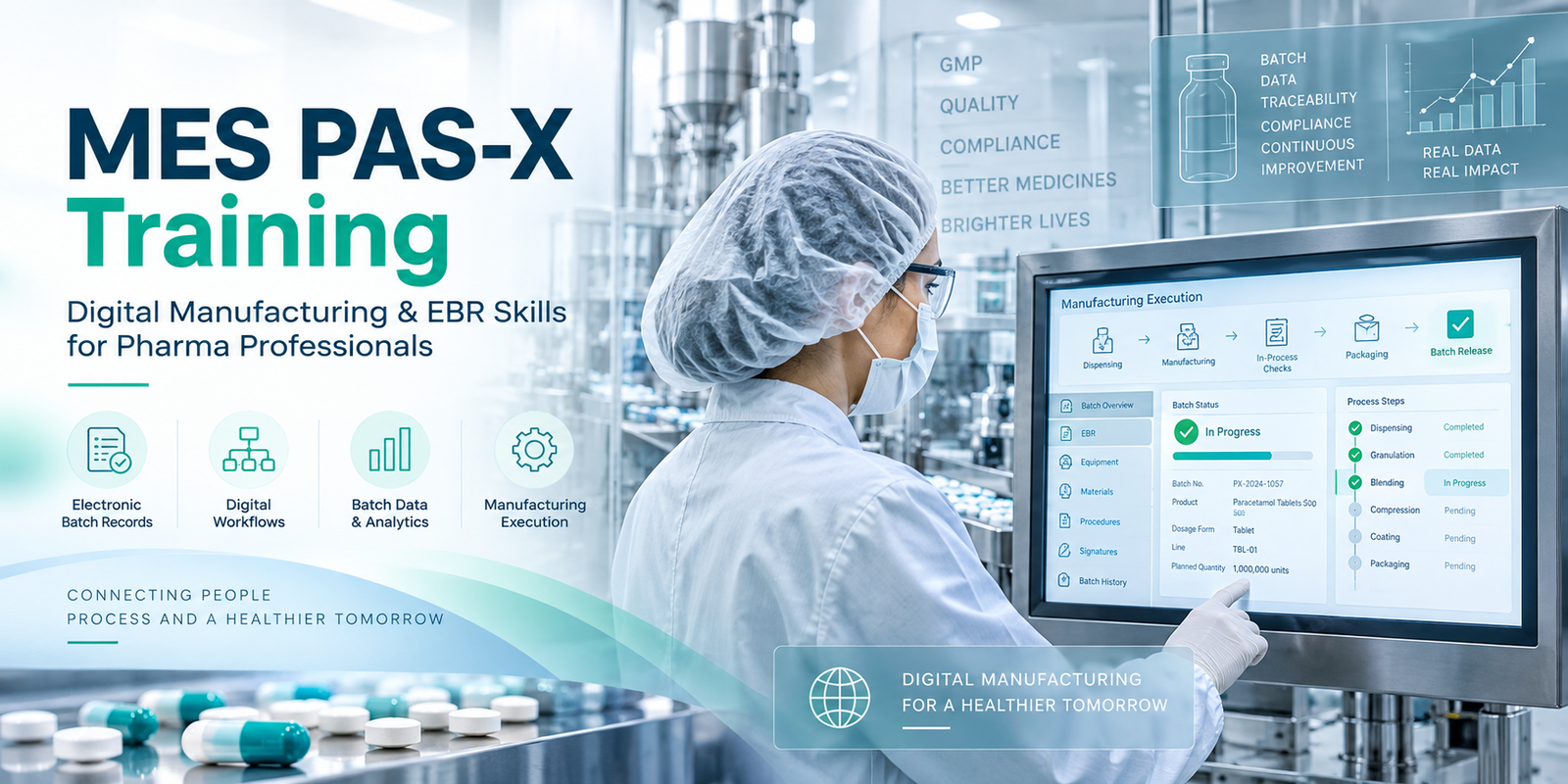
Pharmaceutical manufacturing has always depended on documentation. Every material movement, equipment check, process parameter, operator action, approval, and batch decision needs to be recorded correctly.
For years, much of that work depended heavily on paper batch records. The process worked, but it also created practical problems. Operators had to make manual entries, quality teams had large volumes of documentation to review, and manufacturing information could be spread across different systems and records.
Modern pharmaceutical plants are gradually replacing many of these paper-heavy processes with digital manufacturing systems.
That is where Manufacturing Execution Systems, or MES, become important.
For professionals who want to work with these systems, MES PAS-X Training provides an opportunity to understand how pharmaceutical production can be planned, executed, documented, checked, and reviewed through a digital environment.
Werum PAS-X MES supports functions such as electronic batch recording, Master Batch Record management, weighing and dispensing, production execution, and manufacturing documentation.
But learning PAS-X should not simply mean memorising menus and software screens.
The valuable skill is understanding what is happening behind those screens.
Why is a material being verified? Why does an operator need to complete a particular step before moving ahead? Why is an electronic signature required? Where does the production order originate? How does MES communicate with ERP and shop-floor systems? And what information eventually becomes part of the Electronic Batch Record?
A practical MES PAS-X Training program should help answer these questions.
At Ascents Learning, the training approach focuses on understanding PAS-X in the context of actual pharmaceutical manufacturing workflows so learners can connect software functions with real production requirements.
Why MES Skills Are Becoming More Relevant in Pharmaceutical Manufacturing
Pharmaceutical manufacturing is becoming increasingly connected.
ERP systems may manage planning and business transactions. Automation systems control equipment and process operations. Laboratory systems manage testing information. Manufacturing teams execute production activities on the shop floor.
MES sits between several of these layers.
A Manufacturing Execution System helps coordinate and document what happens during manufacturing.
A simplified environment may look like this:
ERP → MES PAS-X → Production Operations → Equipment and Automation → Manufacturing Records
That makes MES knowledge useful for professionals working across manufacturing, IT, automation, quality, validation, and digital transformation projects.
PAS-X MES can also exchange information with ERP systems and production environments, which is why understanding integration concepts is important for people preparing for MES projects.
This is one reason MES PAS-X Training should cover more than individual software functions.
Learners need to understand the manufacturing ecosystem around the application.
What Exactly Is PAS-X MES?
PAS-X is a Manufacturing Execution System designed primarily for pharmaceutical, biotech, and life-sciences manufacturing environments.
Think of it as a system that helps translate a manufacturing plan into controlled production activities.
A production order might originate in an ERP system. PAS-X then helps manage how that order is executed at the manufacturing level.
Depending on the implementation, this can involve:
- Production orders
- Master Batch Records
- Electronic Batch Records
- Material verification
- Weighing and dispensing
- Equipment status
- Operator instructions
- Process parameters
- Electronic signatures
- Production documentation
- Exception handling
- Batch review
A good MES PAS-X Training course therefore needs to explain both the system and the pharmaceutical processes that the system supports.
Knowing where to click is useful. Knowing why the system requires a particular action is far more valuable.
What MES PAS-X Training Actually Teaches You About Pharma Operations
The strongest PAS-X professionals usually understand both manufacturing processes and the digital workflows supporting them.
That starts with a few core areas.
Understanding PAS-X System Architecture
Before working with individual functions, learners should understand where MES sits within the overall manufacturing technology landscape.
For example, a pharmaceutical manufacturing environment may contain:
- ERP systems
- MES platforms
- Laboratory systems
- Automation systems
- Process historians
- Production equipment
- Databases
- Reporting systems
- Quality applications
An MES professional needs at least a working understanding of how information moves between these systems.
During MES PAS-X Training, learners should therefore study basic PAS-X architecture and system interaction rather than treating the application as an isolated platform.
Master Data Management in PAS-X
Manufacturing depends on accurate master data.
The system needs to know what materials exist, which equipment can be used, which manufacturing resources are available, and which process instructions apply.
Typical master-data-related concepts may include:
- Materials
- Equipment
- Resources
- Recipes
- Production parameters
- Units
- User roles
- Manufacturing structures
Poor master data can create problems much later in the production process.
For example, an incorrect material relationship or equipment configuration may affect whether an operator can execute a production step correctly.
That is why practical MES PAS-X Training should explain not just how master data is configured but also how it affects manufacturing execution.
Recipe and Workflow Configuration
A pharmaceutical manufacturing process is not simply a collection of instructions.
Activities often need to happen in a defined order.
Materials may need verification. Equipment may need to be available and clean. Parameters may need to remain within specified ranges. Operators may need instructions. Certain actions may require confirmation or approval.
In PAS-X, manufacturing requirements can be represented through structured digital processes and Master Batch Records.
This makes recipe and workflow understanding one of the most important areas within MES PAS-X Training.
Electronic Batch Records: The Core of PAS-X Learning
Electronic Batch Records, commonly called EBRs, are central to many PAS-X implementations.
Traditionally, manufacturing information might be recorded on paper throughout production.
With an Electronic Batch Record, much of this information can be captured digitally as production takes place.
An EBR may contain information relating to:
- Operator activities
- Materials used
- Equipment information
- Production times
- Process parameters
- Manufacturing instructions
- Confirmations
- Electronic signatures
- Exceptions
- Batch history
For anyone completing MES PAS-X Training, understanding EBR is more important than simply learning its definition.
You need to understand the entire batch lifecycle.
Paper Batch Records vs Electronic Batch Records
| Paper-Based Manufacturing | PAS-X / EBR-Based Manufacturing |
|---|---|
| Handwritten entries | Structured electronic entries |
| Paper signatures | Electronic signatures |
| Physical batch documentation | Digital manufacturing records |
| Manual document retrieval | Searchable electronic information |
| Manual process guidance | System-guided workflows |
| Extensive paper review | Electronic review processes |
| Separate paper instructions | Instructions presented during execution |
This does not mean that installing MES automatically fixes every manufacturing problem.
Process design, configuration, validation, data quality, user training, and governance still matter.
A useful MES PAS-X Training program should therefore teach learners to think about the manufacturing process first and the software configuration second.
How PAS-X Supports GMP-Controlled Manufacturing Processes
GMP manufacturing depends heavily on consistency, traceability, controlled procedures, and reliable documentation.
MES can help support these operational requirements by guiding users through defined manufacturing processes and recording activities electronically.
Typical areas include:
- Controlled manufacturing instructions
- User authentication
- Electronic signatures
- Material checks
- Equipment checks
- Process confirmation
- Production documentation
- Audit-related records
- Exception handling
- Batch review
However, it is important to understand that software itself does not replace good GMP practices.
The system needs to be designed, configured, tested, maintained, and used correctly.
This is why MES PAS-X Training becomes more useful when GMP concepts are included alongside software instruction.
Why MES Professionals Need GMP Knowledge
Consider a workflow requiring a second-person verification.
Someone unfamiliar with pharmaceutical manufacturing might see that as another software approval.
A pharma professional sees the reason behind it.
The verification may exist because the process requires an independent check before a critical activity can continue.
The same thinking applies to:
- Electronic signatures
- Material verification
- Equipment status checks
- Mandatory instructions
- Parameter limits
- Deviations
- User permissions
Learning the business reason behind a system rule makes troubleshooting and requirement analysis much easier.
A Practical Example: How a Batch Can Move Through PAS-X
Consider a simplified tablet manufacturing batch.
The exact process differs between companies, products, facilities, and PAS-X implementations, but the example helps explain how MES concepts connect.
Step 1: Production Order
A production requirement is created through the company’s planning process and relevant production information becomes available to MES.
Step 2: Batch Preparation
PAS-X identifies the manufacturing requirements associated with the order.
The appropriate recipe or Master Batch Record is selected.
Step 3: Material Verification
Operators work with the required raw materials.
The system may support verification of whether the correct material is being used for the correct manufacturing operation.
Step 4: Equipment Check
Before execution, the process may need to confirm whether the appropriate equipment is available and suitable for use.
Step 5: Operator Instructions
The operator receives instructions associated with the manufacturing process.
Rather than working entirely from printed documents, activities can be presented digitally.
Step 6: Manufacturing Execution
Production activities are completed according to the defined process.
Relevant values, actions, and confirmations are recorded.
Step 7: Process Checks
The workflow may require checks, confirmations, signatures, or process values before allowing the next manufacturing activity.
Step 8: Exception Handling
If something happens outside the expected process, the issue needs to be appropriately documented and managed according to the configured workflow and company procedures.
Step 9: Electronic Batch Record
Manufacturing information captured throughout execution becomes part of the electronic production record.
Step 10: Batch Review
Relevant production and quality personnel review the information according to the organisation’s procedures.
This end-to-end understanding is what makes practical MES PAS-X Training useful.
You are not studying ten unrelated functions. You are learning how those functions connect to one manufacturing batch.
PAS-X Skills That Matter Beyond Software Navigation
Software knowledge is only one part of an MES role.
People working on actual projects also need several supporting skills.
Manufacturing Process Understanding
You should understand how production moves from materials and instructions to finished manufacturing activities.
A learner who understands pharmaceutical operations will usually find PAS-X workflows easier to interpret.
Requirement Analysis
MES consultants frequently work with users who describe business requirements rather than software functions.
For example:
The operator must not proceed until the material has been independently verified.
The consultant needs to understand that requirement and determine how it should be represented within the system.
Workflow Mapping
Manufacturing procedures need to be converted into logical electronic workflows.
That requires careful process thinking.
Troubleshooting
If a batch cannot proceed, the cause may involve:
- Master data
- User permissions
- Material status
- Equipment status
- Workflow conditions
- Interfaces
- Configuration
Strong MES PAS-X Training should help learners think through these relationships.
Documentation
Documentation remains important in pharmaceutical technology projects.
MES professionals may encounter:
- User requirements
- Functional specifications
- Configuration documents
- Test scenarios
- Validation documents
- Process flows
- Change records
Understanding technical functionality without being able to document it clearly can limit your effectiveness on a project.
Who Should Consider MES PAS-X Training?
There is no single background for entering MES work.
Different professionals approach PAS-X from different directions.
Pharma Manufacturing Professionals
People already working in production understand shop-floor operations.
MES PAS-X Training can help them understand how those operations are represented digitally.
Quality and Validation Professionals
Quality and validation professionals are already familiar with controlled processes, documentation, review, testing, and compliance requirements.
That experience can be valuable when working with manufacturing systems.
Automation Engineers
Automation engineers understand equipment, process control, and industrial systems.
Learning MES helps them understand the layer connecting business production requirements with shop-floor execution.
IT Professionals
IT professionals may already understand applications, databases, integrations, infrastructure, and support.
Learning pharmaceutical processes and PAS-X can help them move toward manufacturing technology projects.
Life Sciences Graduates
Graduates from pharmaceutical, biotechnology, life sciences, engineering, or related backgrounds can also learn MES concepts.
For beginners, understanding pharmaceutical manufacturing terminology before moving deeply into configuration is particularly useful.
Functional vs Technical PAS-X Career Paths
Not every PAS-X professional does the same work.
Some roles are more functional. Others are more technical.
Functional PAS-X Work
- Manufacturing requirements
- Process flows
- Master data
- Recipe design
- Master Batch Records
- Electronic Batch Records
- User requirements
- Documentation
- Testing
- Business-user communication
Technical PAS-X Work
- Application configuration
- System environments
- Interfaces
- Integration
- Troubleshooting
- Application support
- Technical deployment
- Database-related work
Many projects require some understanding of both sides.
That is why learners should use MES PAS-X Training to identify where their existing experience fits rather than trying to learn every area at the same depth immediately.
Common Roles Where PAS-X Knowledge Can Be Relevant
Professionals with PAS-X and pharmaceutical MES experience may work in roles such as:
- MES Consultant
- PAS-X Consultant
- MES Engineer
- MES Business Analyst
- MES Support Engineer
- Manufacturing Systems Analyst
- MES Validation Engineer
- Application Support Consultant
- Digital Manufacturing Consultant
- Manufacturing IT Consultant
Job titles vary considerably between organisations.
More important than the title is understanding whether the role focuses on implementation, configuration, business analysis, validation, integration, support, or manufacturing operations.
Skills Employers May Expect Beyond PAS-X
Learning PAS-X alone does not automatically make someone project-ready.
Employers may also value knowledge of:
- Pharmaceutical manufacturing
- GMP principles
- Electronic Batch Records
- Master Batch Records
- Computerised system validation concepts
- Requirement gathering
- Technical documentation
- SQL fundamentals
- ERP concepts
- System integration
- Testing
- Problem solving
- Stakeholder communication
A strong MES PAS-X Training program should therefore connect PAS-X knowledge with the broader environment in which MES professionals actually work.
Common Mistakes People Make While Learning PAS-X
1. Memorising Screens
Learning which button opens a particular function is not enough.
Software versions, configurations, and company implementations can differ.
Understanding the underlying process gives you knowledge that transfers between projects.
2. Ignoring Pharmaceutical Manufacturing
MES exists to support manufacturing.
Trying to understand PAS-X without understanding production processes makes learning unnecessarily difficult.
3. Treating EBR as Just Another Module
EBR connects many parts of manufacturing execution.
Learners should understand how materials, equipment, users, instructions, parameters, signatures, and production information come together in the final batch record.
4. Ignoring Documentation
MES implementation is not simply configuration.
Requirements, testing, validation, changes, and support all involve documentation.
5. Learning Every Topic Separately
Master data, MBR, EBR, equipment, materials, integrations, and execution are interconnected.
Good MES PAS-X Training should demonstrate those connections through complete manufacturing scenarios.
What Should Practical MES PAS-X Training Include?
A practical course should move in a logical sequence.
Learners should first understand manufacturing and MES concepts before going deeply into individual PAS-X functions.
Useful areas include:
- Introduction to MES
- Pharmaceutical manufacturing processes
- PAS-X architecture
- Master data
- Materials
- Equipment
- Master Batch Records
- Recipe concepts
- Electronic Batch Records
- Workflow execution
- Weighing and dispensing concepts
- Production orders
- Electronic signatures
- Exception handling
- GMP-related processes
- System integration concepts
- Project documentation
- Testing scenarios
- Practical exercises
At Ascents Learning, the focus of MES PAS-X Training is practical learning supported by experienced trainers, case-based exercises, assignments, project-oriented scenarios, mentor guidance, and career preparation.
The aim should be to understand how PAS-X works within a real pharmaceutical manufacturing environment rather than treating the platform as a collection of isolated menus.
A Better Learning Roadmap for PAS-X
Stage 1: Understand Pharmaceutical Manufacturing
Learn common production terminology and basic manufacturing workflows.
Stage 2: Learn MES Fundamentals
Understand where MES sits between ERP and the shop floor.
Stage 3: Understand PAS-X Architecture
Learn the major components and how information moves through the system.
Stage 4: Study Master Data
Understand materials, equipment, resources, users, and related configuration.
Stage 5: Learn MBR and Recipe Concepts
Study how manufacturing instructions are converted into executable electronic processes.
Stage 6: Understand Electronic Batch Records
Follow a batch from execution through documentation and review.
Stage 7: Study GMP and Documentation
Understand why manufacturing systems require controls, checks, signatures, and records.
Stage 8: Practice Complete Scenarios
Instead of practising isolated features, follow end-to-end manufacturing cases.
Stage 9: Prepare for Project and Interview Questions
Practice explaining processes clearly.
- What is the relationship between MBR and EBR?
- Where does MES sit between ERP and automation?
- Why is master data important?
- How does material verification work conceptually?
- Why are electronic signatures used?
- What happens when a manufacturing exception occurs?
This approach makes MES PAS-X Training much more meaningful than simply memorising definitions.
Why Practical Training Matters
PAS-X is closely connected with real manufacturing operations.
That means practical examples matter.
Imagine two learners.
One can define an Electronic Batch Record perfectly.
The other can explain how a production order enters MES, how an MBR guides production, how the operator executes manufacturing instructions, how materials and equipment are checked, what information is captured during execution, and how the resulting EBR supports batch review.
The second learner demonstrates a much more useful understanding of MES.
That is the level practical training should aim for.
How Ascents Learning Approaches MES PAS-X Training
Ascents Learning structures its MES PAS-X Training around job-relevant and practical learning.
The learning approach includes:
- Practical hands-on sessions
- Industry-oriented examples
- Trainers with professional experience
- Manufacturing workflow scenarios
- Case studies
- Assignments
- Project-based learning
- Mentor support
- Interview preparation
- Resume and profile guidance
- Online and offline learning options
- Weekday and weekend batches
The purpose is not simply to complete a syllabus.
Learners should finish the training understanding how PAS-X concepts connect to manufacturing activities they may encounter on real projects.
Final Thoughts
The most useful way to learn PAS-X is to stop thinking of it as just another enterprise application.
It is closely connected to what actually happens inside pharmaceutical manufacturing.
Materials arrive. Production orders are created. Recipes define manufacturing requirements. Operators perform activities. Equipment is used. Parameters are recorded. Checks are completed. Exceptions are handled. Signatures are captured. Batch records are reviewed.
PAS-X helps bring these activities into a controlled digital manufacturing workflow.
That is why effective MES PAS-X Training needs to connect software functions with manufacturing logic, EBR, MBR, GMP concepts, documentation, and complete production scenarios.
For pharma, quality, validation, automation, IT, and life-sciences professionals looking to develop manufacturing technology skills, practical PAS-X knowledge can provide a useful foundation for working with modern pharmaceutical MES environments.
Ascents Learning provides MES PAS-X Training with a focus on practical understanding, real-world manufacturing scenarios, project-oriented exercises, trainer support, and career preparation.
Rather than learning only where functions are located in the system, focus on understanding why those functions exist.
That is the knowledge you can carry from training into an actual MES project.
Frequently Asked Questions About MES PAS-X Training
1. What is MES PAS-X Training?
MES PAS-X Training teaches learners how the PAS-X Manufacturing Execution System is used within pharmaceutical and life-sciences manufacturing. Training typically covers MES concepts, master data, Master Batch Records, Electronic Batch Records, production workflows, equipment, materials, documentation, and related GMP processes.
2. What is PAS-X used for in pharmaceutical manufacturing?
PAS-X is used to support and document manufacturing execution. Depending on the implementation, it can support functions such as Electronic Batch Recording, Master Batch Records, operator guidance, weighing and dispensing, materials, equipment management, production documentation, and integration with other manufacturing systems.
3. What is an Electronic Batch Record in PAS-X?
An Electronic Batch Record is the digital record created while a manufacturing batch is being executed. It can contain operator activities, manufacturing instructions, process values, equipment information, materials, confirmations, signatures, and other production information.
4. Who can learn MES PAS-X?
Pharmaceutical manufacturing professionals, validation professionals, quality professionals, automation engineers, IT professionals, biotechnology professionals, life-sciences graduates, and people working with manufacturing technology can consider MES PAS-X Training.
5. Do I need pharmaceutical experience before learning PAS-X?
Previous pharmaceutical manufacturing experience is helpful but is not always essential. Learners from IT, automation, engineering, biotechnology, and related backgrounds can start by developing a good understanding of pharmaceutical manufacturing and MES fundamentals.
6. What skills are covered in MES PAS-X Training?
A comprehensive MES PAS-X Training program may include PAS-X architecture, master data, materials, equipment, recipes, Master Batch Records, Electronic Batch Records, workflow execution, GMP concepts, manufacturing processes, documentation, and integration fundamentals.
7. What jobs use PAS-X knowledge?
PAS-X knowledge can be relevant to roles including MES Consultant, PAS-X Consultant, MES Engineer, MES Business Analyst, MES Support Engineer, MES Validation Engineer, Manufacturing Systems Analyst, and Digital Manufacturing Consultant.
8. Is MES PAS-X Training useful for validation professionals?
Yes. Validation professionals already work with controlled processes, requirements, testing, documentation, and regulated computerized systems. Learning PAS-X can help them understand how those principles apply within pharmaceutical manufacturing execution environments.
9. Can automation engineers learn PAS-X?
Yes. Automation engineers often already understand shop-floor systems and industrial processes. MES PAS-X Training can help them understand the MES layer that connects manufacturing requirements with production execution, documentation, and higher-level enterprise systems.
10. Does Ascents Learning provide practical MES PAS-X Training?
Yes. Ascents Learning offers MES PAS-X Training focused on practical learning, manufacturing scenarios, projects, assignments, trainer guidance, interview preparation, and flexible online and offline learning options.