



Energy and commodity trading systems are not the kind of software you learn by memorising menus.
A trader books a deal. Market prices change. The risk team checks exposure. Operations verifies what needs to happen physically or financially. Cash flows are generated. Settlements follow. Reports are produced. If one piece of information is wrong at the beginning, several teams may feel the impact later.
That is why good OpenLink Endur Online Training should go beyond explaining individual screens or software terminology. The real value comes from understanding how a trade moves through an Energy Trading and Risk Management environment and how different business functions connect.
For someone planning to work in ETRM, the goal should be practical understanding. What happens when a trade is booked? Which market data influences its valuation? Where does risk come from? What happens after the trade reaches operations? How do you investigate a problem when something does not look right?
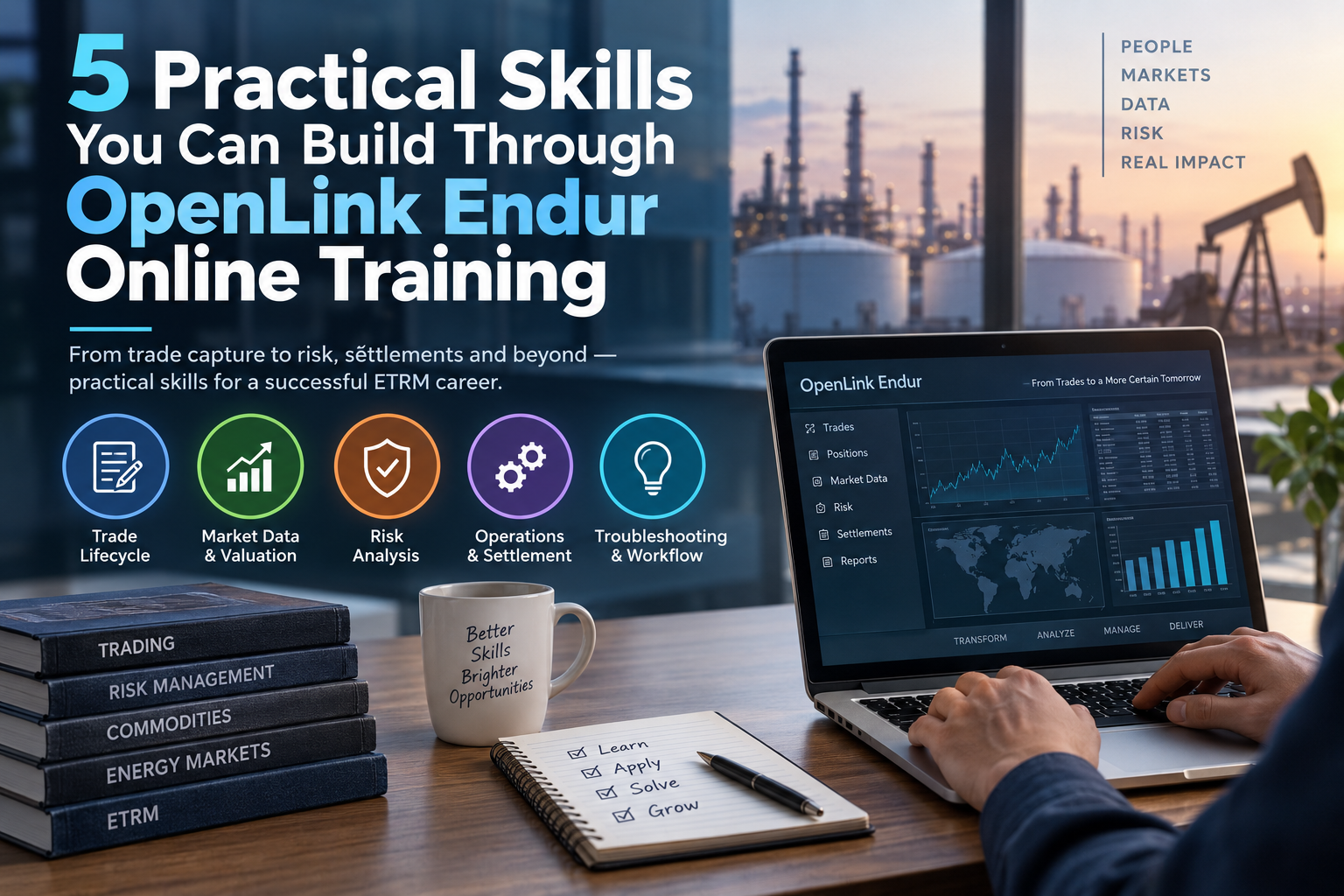
In this article, we will look at five practical skills that learners should aim to build through OpenLink Endur Online Training and why those skills matter in real trading and risk-management environments.
What Is OpenLink Endur and Why Do Practical Skills Matter?
OpenLink Endur is associated with the Energy Trading and Risk Management space, where trading organisations need to manage transactions, positions, market information, risk and downstream processes within connected workflows.
For a learner, however, knowing that Endur is an ETRM platform is only the beginning.
Suppose you know how to enter a trade into a system. That is useful, but what happens next?
You also need to understand questions such as:
- What information defines the trade?
- Which market price or curve affects its value?
- How does the trade contribute to a position?
- What does the risk team see?
- Which operational activities follow?
- When are cash flows generated?
- What happens if the trade information is incorrect?
- How would you trace the problem?
This is where practical OpenLink Endur Online Training becomes valuable. Instead of treating each topic separately, the learner begins to understand the complete business process.
Trade Capture → Market Data → Valuation → Risk → Operations → Settlement → Reporting
The exact workflow varies by organisation, product, commodity and implementation, but the principle remains the same: one business event can affect several downstream functions.
1. Trade Capture and Trade Lifecycle Management
The first practical skill is understanding how a trade enters an ETRM system and what happens to it afterwards.
Understanding What Actually Makes Up a Trade
A trade is more than a buy or sell instruction.
Depending on the product, it can contain information such as:
- Buyer and seller
- Counterparty
- Commodity
- Quantity
- Price
- Currency
- Trade date
- Start and end dates
- Delivery location
- Pricing formula
- Settlement conditions
- Instrument or deal type
- Other commercial terms
Good OpenLink Endur Online Training should help learners understand why this information exists rather than simply showing where each field appears.
For example, imagine an energy company enters into a transaction to purchase natural gas for delivery next month.
The system needs enough information to identify what is being purchased, how much, at what price or pricing formula, where delivery takes place and how financial obligations should eventually be calculated.
A mistake in one of those details may not remain an isolated booking problem. It can affect valuation, position reporting, operational scheduling, invoicing or settlement later.
Following the Trade Through Its Lifecycle
Once a trade is captured, several functions may depend on it.
A simplified trade lifecycle could involve:
Trade Entry → Validation → Valuation → Position → Risk → Operations → Settlement
Understanding this sequence is one of the most useful skills a learner can develop.
Consider a simple example. A trader books a commodity purchase. The trade first becomes part of the organisation’s overall position. Current market information may then be used to calculate its value. The risk team may look at the resulting exposure. Operations may need the trade details for delivery-related activity. Financial information from the transaction may eventually feed invoices or settlement.
A learner who understands only trade entry sees one part of the picture. Someone who understands the lifecycle can see how that trade affects several departments.
That broader understanding is useful for Endur functional consultants, business analysts, application support teams, testers and professionals working between business and technology teams.
2. Market Data, Pricing and Valuation Understanding
Once you understand how trades enter the system, the next question is straightforward: What is the trade worth now?
This is where market data and valuation become important.
Why Market Data Matters
Commodity and energy prices move constantly.
The price agreed when a transaction was booked may be different from the market value of the same exposure later.
Professionals working with ETRM systems may therefore encounter concepts such as:
- Market prices
- Forward prices
- Forward curves
- Price indexes
- Reference data
- Pricing inputs
- Currency rates
- Volatility
- Market scenarios
You do not necessarily need to become a quantitative analyst to start learning Endur, but you should understand the business relationship between market data and the value of a trading position.
Connecting Market Prices With Trade Value
Take a simplified example.
A company agrees to buy a commodity at ₹100 per unit for future delivery. Later, the market value of that commodity rises to ₹115.
The commercial meaning of the position has changed even though the original contractual price has not.
Conversely, if the market falls significantly, the position may look very different from a risk and valuation perspective.
During OpenLink Endur Online Training, the important skill is learning to connect these ideas:
Trade Terms + Market Data = Valuation Context
You should understand where valuation inputs come from, why current market information matters and how changes in those inputs can affect reported values and positions.
Why This Skill Helps in Real Projects
Market-data problems can create confusing downstream symptoms.
Imagine that a position suddenly shows an unexpected value. A beginner may immediately assume that the trade itself is wrong.
Someone with better workflow understanding might investigate several possibilities:
- Was the trade booked correctly?
- Is the correct market price available?
- Is the appropriate curve being used?
- Is reference data correct?
- Was the valuation process completed?
- Is the problem related to reporting rather than the underlying deal?
This way of thinking is far more useful than memorising screens.
3. Risk Exposure and P&L Analysis
Risk management is one of the main reasons ETRM systems are used.
Commodity markets can be volatile. A business may have hundreds or thousands of transactions across products, regions, delivery periods, counterparties and currencies.
Looking at every trade independently would make it difficult to understand the overall commercial picture.
That is why another important outcome of OpenLink Endur Online Training should be the ability to think in terms of positions and exposure.
Moving From Individual Trades to Positions
Imagine that a company has several transactions:
- One purchase position
- Two sales positions
- Another purchase for a different delivery period
- A hedge intended to reduce price exposure
Individually, each transaction tells only part of the story. The business needs to know its combined exposure.
This leads to concepts such as:
- Long and short positions
- Position exposure
- Market exposure
- Realised and unrealised P&L
- Portfolio views
- Price sensitivity
- Risk reporting
Learning to Ask Better Risk Questions
A practical learner should not stop at reading a number on a risk report.
Instead, ask: Why does this number exist?
If P&L changed sharply today:
- Did the market move?
- Was a new trade entered?
- Was an existing trade modified?
- Did market data change?
- Did the portfolio composition change?
- Was a previously missing price loaded?
- Did a process run differently?
That analytical habit matters.
In a real ETRM environment, professionals are often expected to investigate the relationship between system output and business activity.
Good OpenLink Endur Online Training should therefore help learners develop the ability to explain what might be driving an exposure instead of simply reading the final number.
A Simple Risk Example
Suppose a trading desk is exposed to the price of crude oil.
If prices rise or fall sharply, the value of open positions may change. Now imagine that part of the exposure has been hedged.
The relevant business question is no longer simply, “What happened to crude oil prices?”
It becomes: “How did the market movement affect our total portfolio after considering the hedge?”
That is the kind of thinking that separates basic software familiarity from useful ETRM knowledge.
4. End-to-End Operations and Settlement Workflow
A common mistake when learning trading systems is assuming that everything important happens in the front office.
It does not.
After a trade has been captured and assessed from a valuation and risk perspective, it can create work for operations, accounting and settlement teams.
Understanding these downstream activities is the fourth important skill you should develop through OpenLink Endur Online Training.
Understanding Post-Trade Activities
Depending on the organisation and transaction type, post-trade activity can involve areas such as:
- Trade confirmation
- Operational processing
- Delivery information
- Cash flows
- Invoicing
- Reconciliation
- Settlement
- Exception management
- Reporting
The specific process can differ considerably between physical commodities, financial transactions and different energy products.
The important lesson is that the trade continues to matter long after the trader presses “save.”
Front Office, Middle Office and Back Office
You will frequently hear these terms when working around trading systems.
The front office is generally associated with trading and commercial decision-making.
The middle office commonly focuses on areas such as control, exposure, valuation and risk oversight.
The back office typically handles processes such as confirmations, accounting, invoicing and settlements.
Organisations structure these responsibilities differently, so these should not be treated as rigid definitions.
What matters for an Endur learner is understanding how information moves across these functions.
What Happens When Upstream Information Is Wrong?
Imagine a trade contains an incorrect settlement date.
The trader may not immediately notice a problem. The risk view might even appear reasonable.
But when the settlement process begins, the incorrect date can become important.
Now the support team needs to investigate.
Is the settlement process itself faulty, or did incorrect information enter the system earlier?
This is why end-to-end understanding is so valuable.
OpenLink Endur Online Training should help students build exactly this kind of process awareness.
5. Workflow Analysis and Endur Troubleshooting Skills
The fifth skill is less obvious, but it may be one of the most valuable: learning how to investigate problems logically.
Enterprise trading systems have many connected components.
When something goes wrong, the visible problem may not be the original cause.
Stop Thinking Only in Terms of Screens
A beginner often thinks:
“The value on this screen looks wrong. Something on this screen must be wrong.”
An experienced support professional thinks differently.
They ask:
- Which process produced this result?
- Which trade is involved?
- Which data does the calculation depend on?
- Did the correct market information arrive?
- Was the expected process executed?
- Did anything change upstream?
- Which downstream systems received the data?
- Is this a transaction, data, configuration or process problem?
This difference in thinking matters.
A Practical Troubleshooting Scenario
Suppose a risk report does not show the expected exposure for a trade.
There are several possible causes.
The trade may not have been captured correctly. Market data required for valuation may be missing. A relevant process may not have completed. The trade may be classified differently from what the user expects. Reporting logic may also be involved.
Instead of randomly checking screens, a structured approach follows the data:
Trade → Inputs → Processing → Valuation → Risk Output
That process-oriented thinking is exactly what case studies and practical exercises should develop.
Why Scenario-Based Learning Helps
If training consists only of watching demonstrations, learners may remember individual steps without understanding why they performed them.
Scenario-based learning is different.
You might receive a situation such as:
A trade appears correctly in one area, but its expected valuation is missing.
Now you have to investigate.
That forces you to combine:
- Trade knowledge
- Market-data understanding
- Valuation concepts
- Risk awareness
- Process logic
- Troubleshooting
For this reason, practical OpenLink Endur Online Training should include business scenarios wherever possible.
How These Five Endur Skills Work Together
The five skills discussed above should not be treated as separate subjects.
They form one connected workflow.
1. Trade Capture
A transaction enters the ETRM environment.
2. Market Data and Valuation
Relevant market information helps determine its current economic value.
3. Risk Analysis
The transaction contributes to the organisation’s overall position and exposure.
4. Operations and Settlement
The trade creates downstream operational and financial obligations.
5. Workflow Analysis
When something goes wrong, professionals trace the problem across these connected areas.
The broader picture looks like this:
Trade Capture → Market Data → Valuation → Risk → Operations → Settlement → Reporting
A strong learner does not simply know each stage. They understand the relationships between them.
This is the real practical value of OpenLink Endur Online Training.
Who Should Consider OpenLink Endur Online Training?
Endur knowledge can be relevant to people coming from several professional backgrounds.
Energy and Commodity Trading Professionals
People already working with oil, gas, power, commodities or related markets may want stronger system knowledge to understand how trading activity is managed inside an ETRM environment.
ETRM Functional Consultants
Functional consultants need a combination of business-process understanding and platform knowledge.
They may work on requirements, configuration, workflows, testing, implementation or user support.
Business Analysts
Business analysts frequently work between users and technology teams.
They need to translate business requirements into processes that technical or implementation teams can understand.
Application Support Professionals
Support teams may investigate production issues involving transactions, market data, processes or downstream outputs.
Testing Professionals
Testing an ETRM platform involves more than checking whether a button works.
A tester may need to understand whether the correct business result is produced after a series of connected processes.
Professionals Moving Into ETRM
People from finance, technology, commodities, operations or enterprise applications may also consider OpenLink Endur Online Training as part of a move into the ETRM domain.
Functional Skills vs Technical Skills in OpenLink Endur
Not every Endur professional does the same job.
A useful distinction is between functional and technical skills.
Functional Endur Skills
- Trade lifecycle
- Product behaviour
- Market data
- Valuation
- Risk
- Operations
- Settlements
- Business requirements
- Testing
- Workflow design
Functional consultants need to understand what users are trying to achieve and how the system supports the business process.
Technical Endur Skills
Technical responsibilities can involve areas such as:
- System configuration
- Data handling
- Integrations
- Interfaces
- Automation
- Scripting or development
- Technical troubleshooting
- Performance-related work
- Customisation
The exact technical requirements vary considerably by company and project.
That is why learners should choose their OpenLink Endur Online Training according to the type of role they want rather than simply looking for the longest syllabus.
What Should Practical OpenLink Endur Training Include?
Before choosing a course, look beyond the number of modules.
A useful training program should help you understand the business logic behind the system.
Look for areas such as:
- End-to-end trade lifecycle
- Practical trade examples
- Commodity and energy-market context
- Market-data concepts
- Valuation basics
- Position and exposure analysis
- P&L concepts
- Front-to-back workflows
- Operations and settlement concepts
- Realistic exercises
- Case studies
- Troubleshooting scenarios
- Assignments
- Trainer-led doubt resolution
- Interview preparation
The important word here is context.
Learning how to generate a particular output is useful. Understanding why the business needs that output, which data it depends on and what you would check if it looks wrong is considerably more useful.
Learning OpenLink Endur With Ascents Learning
At Ascents Learning, the focus of OpenLink Endur training is on connecting software concepts with practical ETRM workflows.
The objective is not simply to work through a list of topics. Learners need to understand how trading, market information, risk and downstream activities relate to one another.
The OpenLink Endur Online Training approach at Ascents Learning includes practical, instructor-led learning with attention to real business scenarios and job-oriented understanding.
Learners can work on areas such as trade workflows, risk concepts, operational processes and scenario-based exercises while receiving guidance from experienced trainers.
Ascents Learning also provides learning support through assignments, doubt-clearing sessions, interview preparation, resume guidance and career support.
For working professionals, online and flexible batch options can make it easier to develop ETRM knowledge alongside an existing role.
The more important point, however, is what a learner should be able to explain after training.
Instead of saying:
I know where to enter a trade.
You should gradually be able to explain:
I understand how the trade enters the workflow, which information influences its value, how it affects exposure, what downstream processes depend on it, and where I would start investigating if the expected result is missing.
That is a much stronger form of practical knowledge.
Career Roles Where OpenLink Endur Skills Can Be Useful
Depending on your previous experience and additional technical or domain skills, Endur knowledge can be relevant to roles such as:
- OpenLink Endur Functional Consultant
- Endur Business Analyst
- ETRM Consultant
- Endur Application Support Professional
- Trading Systems Analyst
- Commodity Trading Operations Professional
- Risk Systems Analyst
- ETRM Testing Professional
- Endur Technical Consultant
The qualification requirements differ from employer to employer.
Completing OpenLink Endur Online Training does not automatically make someone ready for every Endur role. Previous experience in technology, energy markets, finance, commodities, risk, operations or enterprise systems can significantly influence which opportunities are appropriate.
How to Get More Value From OpenLink Endur Online Training
Understand the Full Trade Lifecycle
Whenever you learn a new feature, ask where it sits in the broader process.
What happens before it? What happens afterwards? Which team uses the result?
Learn the Business Reason Behind Each Process
Do not memorise a sequence simply because the trainer demonstrated it.
Ask why the organisation needs that process.
Practice Scenarios Instead of Memorising Steps
Suppose a trade value appears incorrect. Try to list five possible causes.
Suppose a settlement output is missing. Work backwards through the process.
These exercises develop the kind of thinking needed in consulting and support roles.
Learn Basic Commodity-Market Concepts
Even a basic understanding of energy and commodity trading can make OpenLink Endur Online Training considerably easier.
Learn common terminology around trades, positions, pricing, curves, exposure, hedging and settlement.
Strengthen Your Risk Vocabulary
Become familiar with concepts such as:
- Position
- Exposure
- P&L
- Market risk
- Hedge
- Valuation
- Realised and unrealised results
Practice Explaining Workflows
A good test of your understanding is whether you can explain a process without looking at the software.
For example, ask yourself: What happens after a trade is captured?
Try answering that question clearly in two minutes. This exercise is also useful when preparing for interviews.
Final Thoughts
The most valuable thing you can gain from OpenLink Endur Online Training is not a collection of software steps.
It is an understanding of how a trading business process fits together.
Start with the trade. Understand the market information that affects it. See how valuation changes. Connect that valuation with positions and risk. Follow the transaction into operations and settlement. Then learn how to trace the workflow when the expected result does not appear.
Those five practical skills — trade lifecycle management, market data and valuation, risk analysis, operations and settlement, and workflow troubleshooting — create a much stronger foundation for working with ETRM systems.
For professionals planning to enter this field, Ascents Learning’s OpenLink Endur Online Training can provide a structured way to build those skills through practical instruction, business scenarios and career-focused learning.
The goal should not simply be to say that you have learned Endur.
The goal should be to understand what is happening inside the trading process and be able to explain why.
Frequently Asked Questions About OpenLink Endur Online Training
1. What is OpenLink Endur Online Training?
OpenLink Endur Online Training is structured learning focused on understanding Endur and the business processes surrounding Energy Trading and Risk Management. Training may cover areas such as trade capture, trade lifecycle, market data, valuation, risk, operations and settlement workflows.
2. What skills can I learn through OpenLink Endur training?
Key skills can include trade lifecycle understanding, market-data concepts, valuation awareness, position and risk analysis, front-to-back operations, settlement processes and workflow troubleshooting.
3. Is OpenLink Endur difficult for beginners to learn?
Beginners can learn Endur, but basic knowledge of trading, commodities, finance, energy markets or enterprise applications can make the concepts easier to understand. A structured OpenLink Endur Online Training program can help learners build the concepts in the correct sequence.
4. Who should learn OpenLink Endur?
Endur training can be relevant for ETRM consultants, business analysts, application-support professionals, testers, trading-operations professionals, risk professionals and IT specialists working with energy or commodity trading environments.
5. What is the difference between ETRM and OpenLink Endur?
ETRM stands for Energy Trading and Risk Management and refers to the broader category of business processes and software used to manage energy trading activities. OpenLink Endur is a technology platform associated with this area.
6. Does OpenLink Endur training include risk management?
Risk is an important part of ETRM. OpenLink Endur Online Training may therefore include concepts such as positions, exposure, valuation, P&L and the relationship between market movements and trading portfolios.
7. What career roles can I pursue after learning OpenLink Endur?
Relevant roles can include Endur Functional Consultant, ETRM Consultant, Business Analyst, Endur Application Support Professional, ETRM Tester, Risk Systems Analyst and Endur Technical Consultant. Actual eligibility depends on your existing skills, experience and individual employer requirements.
8. Is OpenLink Endur Online Training suitable for working professionals?
Yes. Online learning can be useful for working professionals because it allows them to build ETRM skills while continuing their existing work. Flexible weekday or weekend batches can be particularly useful when available.
9. Should I learn energy trading before learning Endur?
You do not need to become a commodity trader first, but understanding basic concepts such as trade lifecycle, pricing, market data, positions, hedging, risk and settlement can make Endur much easier to learn.
10. How should I choose an OpenLink Endur Online Training program?
Look for training that teaches complete business workflows rather than isolated software steps. Practical scenarios, experienced instructors, assignments, trade-lifecycle coverage, risk concepts, troubleshooting exercises, doubt-clearing support and interview preparation are useful indicators of a structured program.